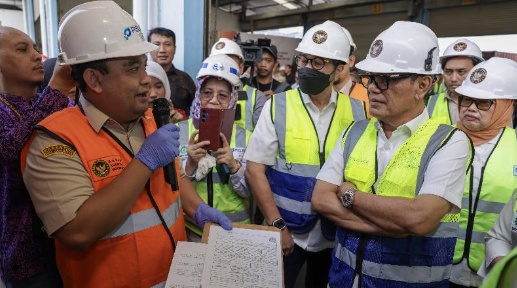
triggernetmedia.com – Member of Commission IV of the Indonesian House of Representatives (DPR RI), Herry Dermawan, urged strengthened coordination between the central and regional governments to anticipate the impact of drought on the agricultural sector. He made this statement during a meeting at the Quarantine inspection point at the Multi Terminal Indonesia Common Area (MTI CA) at Tanjung Priok Port, North Jakarta, Friday (October 2, 2026).
Herry responded to the drought, which, according to data from the Ministry of Agriculture, has affected around 50,000 hectares of rice fields in Indonesia. He stated that the government has prepared several programs to support water availability for agricultural land, including the development of pumped irrigation and piped irrigation.
However, he believes the program’s implementation in the regions still needs strengthening. According to Herry, the problem lies not only with the central government’s readiness, but also with communication and coordination with local governments.
“So it’s just a matter of communication. The government is actually ready, but implementation isn’t yet. There may also be issues within the ministry regarding pumped irrigation, piped irrigation, and tertiary irrigation,” Herry said.
He explained that pumped irrigation involves drawing water from a source using a pump, while piped irrigation uses a pumping system that then distributes the water through a network of pipes. According to Herry, one thing that requires attention is the absorption rate of both programs, which has not met expectations.
“Tertiary irrigation requires a large water source. Pump irrigation requires drilling. Pipe irrigation also requires drilling, but the water is diverted to pipes. The absorption capacity of these two programs is likely not as we expected,” he explained.
Herry stated that district and provincial governments need to be more proactive in communicating their regional needs to the central government. This way, prepared programs can be implemented according to conditions and needs on the ground.
“This will ultimately foster communication between those at the bottom and those at the top. From the district, the District Agriculture Office, the province, and the Ministry of Agriculture. This is what we need to improve. If preparations are in place, everything will be ready at the beginning of the year,” he said.
He added that the central government cannot build all agricultural infrastructure needs without proposals from local governments. Therefore, regions need to communicate their needs and challenges so that joint solutions can be found.
“It’s likely to be implemented locally, as the central government doesn’t dare build without a request from the region. It would be better if the region could also request the central government, but what obstacles are there? I don’t know, but we’ll discuss that later,” Herry said.
According to Herry, synergy between the central and regional governments is a crucial factor in addressing the threat of drought to the agricultural sector. Improved communication is expected to increase the uptake of water supply programs for agricultural land and support sustainable production in drought-affected areas.
“The most important thing is synergy. The government has already prepared the equipment and other necessary resources,” he concluded.
About Author